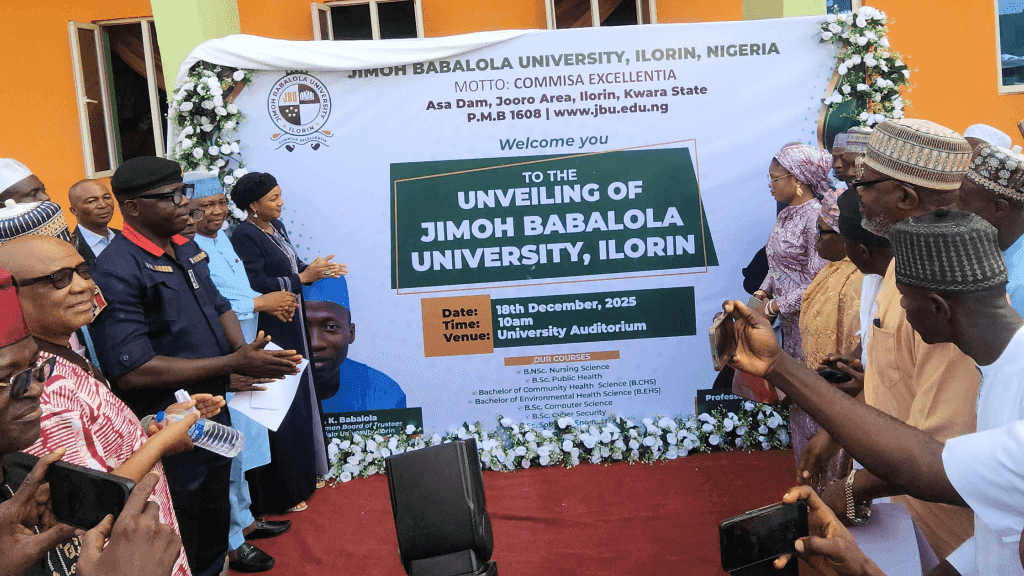
About Jimoh Babalola University
The Story of Jimoh Babalola University
Jimoh Babalola University was established to advance the educational vision of its founder, Jimoh Babalola. According to the university’s official history, the project developed from his determination to provide young Nigerians with a clearer sense of purpose, greater capacity for personal and professional growth, and the values needed to contribute positively to society.
Academic Programs & Excellence
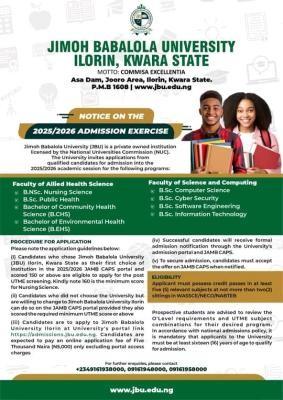
In January 2026, the Executive Secretary of the NUC, Abdullahi Ribadu, disclosed that more than 879 new academic programmes were introduced across Nigerian universities in 2025 under the newly approved Core Curriculum and Minimum Academic Standards (CCMAS). He noted that the framework is designed to transform the Nigerian University System by producing globally competitive graduates, integrating 21st-century skills such as digital literacy, entrepreneurship, and problem-solving into academic curricula. Jimoh Babalola University (JBU) is a private university located in the Asa Dam, Jooro area of Ilorin, Kwara State, Nigeria. The institution offers academic programmes in allied health sciences, science and computing, with a focus on preparing students for professional careers through university education, practical learning and skills development. Its academic pathways include undergraduate degree programmes, the Joint Universities Preliminary Examinations Board (JUPEB) and the Interim Joint Matriculation Board (IJMB). For the 2026/2027 academic session, Jimoh Babalola University has announced that admission applications are open. Its published undergraduate programme list includes Nursing Science, Public Health, Community Health, Environmental Science, Information and Communication Technology (ICT), Cybersecurity, Software Engineering and Computer Science. Applicants should check the current application portal to confirm the exact programme title, entry requirements and availability of their preferred course. Jimoh Babalola University lists the following undergraduate programmes on its official website. Some of the university’s online admission pages use related programme descriptions, including Environmental Health, Public Health Science and Information Technology. Applicants should therefore confirm the exact approved programme title and its availability on the current application portal before completing registration. Admission requirements at Jimoh Babalola University depend on the applicant’s entry route and intended programme. Candidates can apply through UTME or Direct Entry, subject to the university’s requirements and the applicable national admission procedures. Participate in the JAMB UTME and meet the university’s current minimum score. Satisfy the specific UTME subject combination and other departmental requirements for the intended programme.
Campus & World-Class Facilities
Establishing a university is no small feat, especially in a country where private institutions often face significant financial and operational challenges. But Alhaji Babalola is undeterred. “The funding of the university will come from multiple sources,” he said. As an exporter with a thriving business, he has already made significant personal investments. “We are also leveraging bank facilities and exploring external funding opportunities, both locally and internationally.” When asked about the return on investment, his response was both pragmatic and altruistic. “Establishing a university is like serving humanity. We are not expecting quick profits. For now, our focus is on growth and expansion.” This long-term perspective is reflected in the university’s infrastructure plans. While starting with modest facilities, he assured me that the structures would evolve to meet global standards. “It’s not about the landscape; it’s about building what you need for the purpose it serves.” Jimoh Babalola University advertises on-campus hostel accommodation for students. Its admission information describes accommodation as available to students, providing an option for candidates who prefer to live within the university environment. The university advertises on-campus hostel accommodation. Applicants should contact the institution to confirm current availability, room categories, accommodation fees and the procedure for booking a room. Internet access, computer-based test halls, MIS support, student portal helpdesk, software licences, and IT training programmes. Free WiFi in most academic buildings. On-campus cafeterias, kiosks and food courts serving local and continental meals. Prices range from ₦800 to ₦2,500 per meal. Several halls have private bukas nearby. Internal shuttle bus service connecting hostels, lecture theatres and gates. External Keke and Okada parks at major gates. Ride-hailing apps available off-campus. 🏠 How accommodation works at Jimoh Babalola University, Ilorin, Kwara State On-campus hostels are allocated via the student portal after acceptance fee payment. Space is usually limited — fresh students get priority. Off-campus lodges are privately managed in nearby neighbourhoods, with rents typically paid yearly. Jimoh Babalola University, Ilorin, Kwara State Hall 0 is one of the official on-campus hostels at Jimoh Babalola Univers... Jimoh Babalola University, Ilorin, Kwara State Hall 1 is one of the official on-campus hostels at Jimoh Babalola Univers...
Life at Jimoh Babalola University
The inspiration for Jimoh Babalola University came from observing the increasing number of students unable to gain admission into existing higher institutions. “We discovered that the universities we have are not enough to accommodate all the students,” he explained. “This is the gap we want to bridge to assist the government and reduce the number of dropouts in our communities.” “We are focusing on practical education, not just theory,” he emphasised. “We want our students to graduate with the skills and character needed to make a difference wherever they find themselves.” This commitment extends to the university’s mission to align with the economic realities of its environment. “We are building value in our students' character and morals that will enable them to work effectively within their communities and beyond.” The university’s development followed earlier educational activities associated with its founder. These experiences helped shape the vision of establishing a higher institution that could offer students opportunities to pursue academic qualifications and prepare for professional careers. The university’s history describes the process as one that involved financial challenges, bureaucratic hurdles and scepticism about the founder’s plans. The institution’s philosophy is expressed through the principles of clarity, capacity and civility. Clarity refers to helping students identify their goals and make purposeful decisions; capacity focuses on developing knowledge and abilities; and civility emphasises responsible conduct and constructive participation in society. Today, Jimoh Babalola University identifies Allied Health Sciences and Science and Computing among its principal academic areas. Its programme offerings include healthcare-related disciplines and computing courses intended to prepare students for opportunities in health services, technology and other professional fields. The university’s official website also publishes institutional news covering academic activities, leadership and programme development. Prospective students can consult these announcements to follow developments affecting the institution and its academic offerings. Prospective students should therefore check the latest schedule before budgeting for admission. Tuition may vary by programme and academic pathway, while accommodation and other applicable charges may be billed separately.
Key Information
- School Type
- private
- Curriculum
- Nigerian
- Levels Offered
- Not specified
- Student Type
- Day Only
- Gender
- Co-ed
Learn more about Jimoh Babalola University from these trusted sources:
- 1
- 2
- 3
- 4
- 5