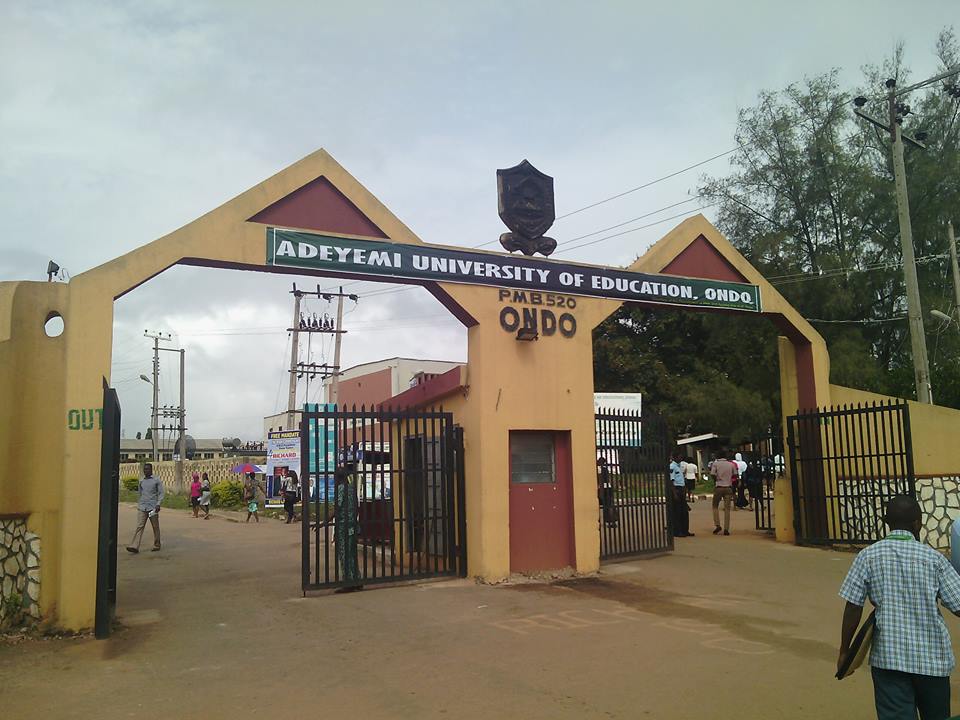
The Story of Adeyemi Federal University Staff School
This is not another list copied from the internet. It is a painstakingly researched 475-page, full-colour, hardcase encyclopedia that documents the establishment, founders, foundation staff, foundation students and distinguished alumni of the first 116 public secondary schools in Nigeria, from the founding of CMS Grammar School, Lagos in 1859 to the schools established on the eve of independence in 1959. The book, which carries a Foreword by Emeritus Professor F. A. Fajemirokun, former Vice-Chancellor of University of Lagos, does what few have attempted: it attempts to verify founding dates, many of which have been muddled by oral tradition and schools that evolved from primary to secondary status. While the author honestly admits that the ranking by year of establishment should be read as his best assessment based on available evidence, the sheer effort to visit schools, contact principals, and collate alumni photographs gives the work credibility. He said that in the life of the FCSC spanning decades, his leadership for the first time also introduced a strategic plan that secured the buy-in of a large pool of stakeholders. He said that the strategic plan would run for five years.
Academic Programs & Excellence
Over the years, AFUED has evolved into a comprehensive university offering a range of academic programs. The university comprises five main schools: Arts and Social Sciences, Education, Languages, Sciences, and Vocational and Technical Education, encompassing a total of 28 academic departments. It maintains an affiliation with Obafemi Awolowo University, Ile-Ife, for its degree programs. He said that the meeting was situated within the reform journey that the council pursued together in Katsina in 2024 when it committed to institutional re-engineering and a stronger governance partnership with respective governments and in Umuahia in 2025 when the council examined the FCSC Strategic Plan, 2026–2030, and the imperative of restoring a capable, citizen-centred and accountable civil service.
Life at Adeyemi Federal University Staff School
Two features stand out. First, the listing of foundation staff and foundation students — a goldmine for historians and Old Students’ Associations searching for their roots. Second, the special section devoted to photographs and profiles of distinguished personalities produced by these schools — a visual reminder that these institutions collectively produced the architects of modern Nigeria. Physically, the book, published by Lord Keynes Publishing Company, Akure, Ondo State, matches its ambition. Printed in all colours on glossy art paper and bound in a hardcase, it is clearly not designed for the average student’s backpack. It is a collector’s edition and reference material — meant for university libraries, secondary school libraries, National Archives, Old Students’ Association secretariats, corporate boardrooms, and the homes of those who value heritage. The Trailblazers is not without limitations, which the author himself acknowledges in the Preface. Some photographs are still being awaited from alumni bodies, and founding date controversies will continue. Indeed, that is the book’s strength — it is presented as a “work in progress”, an invitation to Old Students’ Associations to come forward with records to enrich future editions. Adeyemi Federal University of Education (AFUED), formerly known as Adeyemi College of Education, is a prominent federal institution located in Ondo City, Ondo State, Nigeria. Established in 1963 and commencing operations on May 22, 1964, with an initial cohort of 93 students, the institution was named in honor of Canon M.C. Adeyemi, a notable educationist in the region. Its primary mission was to train qualified teachers for secondary schools and teacher training colleges, as well as to conduct research on teaching methodologies across various educational levels in Nigeria. The Chairman, Federal Civil Service Commission ( FCSC), Prof. Tunji Olaopa, has disclosed that some indigenes of Delta State whom he referred to as icons played a huge role in shaping his intellectual and career development. Listing those who influenced his intellectual development, he mentioned the late Professors Billy Oritsesaninomi Dudley and Peter Palmer Ekeh, his political science teachers at the University of Ibadan; the late Prof. Onigu Otite, a giant anthropologist; Emeritus Professor Godwin Sogolo, his philosophy teacher; Prof. C. O. Ikporukpo, transport/industrial geographer; Prof. Patrick Utomi at Lagos Business School; the late Prof. Andrew Owhona, his PhD project supervisor in ABU, Zaria, among others.